Python Pop Quiz - Number Explosion
You will sometimes come across examples of code that use one or two asterisks. Depending on how the asterisks are used, they can mean different things to Python.
Check your understanding of what a single asterisk means in the following quiz!
The Quiz
What will be the output if you run this code?
A) {range}
B) (range)
C) [0, 1, 2]
D) (0, 1, 2)
E) {0, 1, 2}
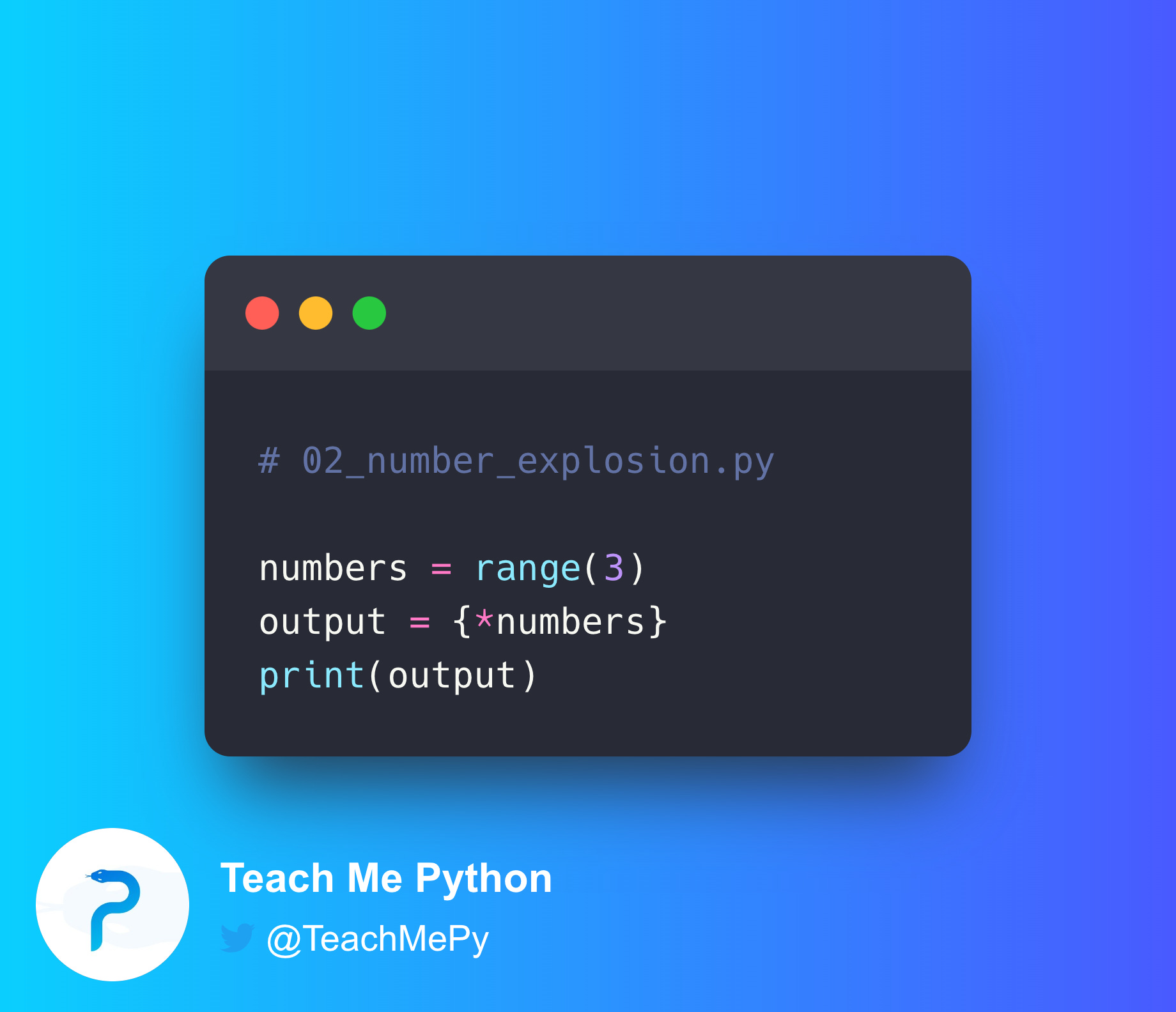
Stop here and try to figure out the quiz above. When you are ready, you can continue to the answer!
The Answer
E) {0, 1, 2}
Explanation
A single asterisk before a Python dictionary or list is known as the unpacking operator. In this example, you tell Python to unpack three integers (0 - 2) into a set.
Here is the example running in a REPL:
>>> numbers = range(3)
>>> output = {*numbers}
>>> print(output)
{0, 1, 2}
>>> print(type(output))
<class ‘set’>The output of the code shows that you have created a set!
You can also use a single asterisk to unpack a dictionary’s keys:
>>> my_dict = {1: “one”, 2: “two”, 3: “three”}
>>> print({*my_dict})
{1, 2, 3}If you want to take your knowledge of unpacking further, it can help to see Python functions use asterisks:
>>> def my_func(*args):
... print(args)
...
>>> my_func(1)
(1,)
>>> numbers = range(3)
>>> output = {*numbers}
>>> my_func(output)
({0, 1, 2},)
>>> my_func(*output)
(0, 1, 2)When you see a single asterisk in a function definition, the asterisk means that the function can take an unlimited number of arguments. In the second example, you pass in the set as a single argument, while in the last example, you use a single asterisk to unpack the numbers and pass them in as three separate arguments.
For more information, see PEP 448 – Additional Unpacking Generalizations, which has many more examples!
Get the Book
Want more Python quizzes? Check out my book, The Python Quiz Book.


Great breakdown of the unpacking operator! I actually got burned by this once when debugging a data pipeline where I expected a list but kept getting sets. The part about function arguments is clutch tho, it took me forever to understand why my wrapper functions werent working until I realized the difference between passing a collection versus unpacking it with *args.